Why Property Listings Are Broken in Kenya


Let's begin by taking a look at complaints from house hunters on social media.





I could share more social media posts, but I think I've made the point. Finding a home online in Kenya should be simple. Somehow, it isn't.
If you try searching online for a house, apartment or plot of land in Kenya, whether to rent or buy, you'll quickly run into some annoying things. Most of the larger websites are better at this now, but a personal annoyance of mine is when a listing doesn't show the date it was published. Am I looking at something posted today or a year ago? You might only find out after contacting the agent, who tells you the apartment was rented months ago or the plot was sold long ago.
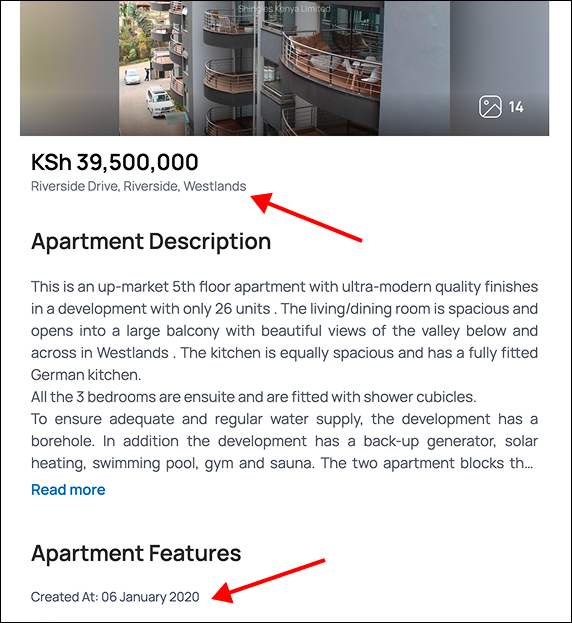
This is a recent (Aug 2026) screenshot from a listing on one of the most popular property websites in Kenya. This listing is over six years old, but at least they show the date, so points for that. Also, Riverside Drive is NOT in Westlands. We'll come back to the location problem later.
Other common problems are bad photos, not enough photos, or photos that simply aren't useful. Saying some of them are bad is an understatement. The examples below come from three separate (and very real) listings for land on a popular property website. It's hard to see how any of them would help a potential buyer make a decision.

Land for sale. Two men and a calf included for scale.

Land for sale. Sorry, a City Shuttle is blocking the view.

Land for sale. No photo of the actual land, so here's some grass from Google.
Kenya has had property websites for years, and many of them have improved significantly. Yet the same complaints about listings remain. The instinct has been to keep improving the technology. That helps, but it doesn't fix underlying problems.
A good listing should get you most of the way to a decision on its own. Everything after that is just confirming what it told you. By the time you contact an agent, you should already have a clear sense of what is being offered. The next step is to verify it on the ground and carry out proper due diligence. That means having basics like good photographs, the date the listing was posted and enough location information to understand where the property actually is. It should also include the context that matters for that type of property. For an apartment, that might mean parking, backup power, and amenities. For a remote plot, things like road access, electricity and water availability are important.
There's a lot of information we can cover in a listing, but let's focus on two things that make a big difference: the agent and the location of the property.
Story time: I once enquired about an apartment on a popular property website. The agent confirmed that the unit was still available; we agreed on a time to meet, and he sent me a location pin. Unfortunately, when I arrived, I realised he had sent me to a completely different apartment. There were similarities: both were two-bedroom units in Westlands, but it was not the one I had seen online. The agent had been dishonest and had got me to make the trip to see a different apartment. He was hoping I would simply consider this other apartment instead.
Here's another story from someone I know. Let's call him Sam. Sam found an apartment through an agent, viewed it and was given a move-in date. The agent had access to the unit so everything appeared legitimate. Sam paid a deposit, packed his belongings and arrived on move-in day expecting to start settling into his new home. The caretaker stopped him and asked what he was doing there. When Sam explained that he was a new tenant, the caretaker told him the owner had never put the apartment up for rent. The person Sam had been dealing with was a fraudster.
These stories expose the same problem: there is often very little accountability attached to the agent or individual behind a property listing.
Kenya has a legal framework for estate agents and the Estate Agents Act requires people practising as estate agents to be registered. There's also the Estate Agents Registration Board (EARB), which is responsible for maintaining the register and regulating professional conduct. Its job includes protecting the public by ensuring that practising agents meet an acceptable standard of competence and conduct. The Act gives EARB powers to investigate complaints and discipline registered agents. It can suspend an agent, caution them or remove them from the register. Practising as an estate agent while unregistered is itself an offence.
The most recent gazetted list of estate agents, published in March 2026, showed that only 707 agents had renewed their annual practising certificates. That works out to roughly one practising agent for every 77,000 Kenyans. Clearly, those 707 people represent only a fraction of the people actually connecting buyers, sellers, landlords and tenants every day.
Having registration information visible on listing websites would be a really good thing. But registration alone doesn't give you a useful history of an agent's conduct or reputation. That doesn't all have to be EARB's job, but it can make sure the regulatory framework actually works and make authoritative public information easier to access. Private companies can build on top of that, whether through agent directories, verified reviews, transaction histories or even ideas nobody has tried yet. The regulator doesn't need to build every solution. It can provide a trustworthy foundation for others to build on.
That 707 figure should also raise another question. If far more people are clearly participating in property transactions every day, why are so many operating outside the formal system? Maybe some are simply ignoring the rules. But EARB should also be willing to ask whether the path into the profession still makes sense for the market we actually have, and whether unnecessary barriers are making it harder for people to enter a system where there could at least be some accountability.
Now let's talk about location. The exact location of a property on a listing website matters. Not every listing is vague. Some give you a reasonably good sense of the location by naming a nearby road or landmark, while others provide little more than the name of a neighbourhood or a very broad area. A location listed simply as “Kilimani” isn't very useful. An apartment near Yaya Centre can be very different from one in a quieter part of the neighbourhood.
At first glance, the solution seems obvious: require an exact pin. But requiring that doesn't mean the person creating the listing has a reason or incentive to provide it.
Imagine an agent has spent time sourcing a property to sell or rent. They have met the owner, visited the property, taken photographs, prepared the listing and started marketing it. If they publish the exact location, another agent may be able to identify the property, approach the owner directly and offer to sell it. That partially explains why locations are often deliberately vague. It creates a poor experience for the buyer, but in the current market it can make sense for the agent. If sharing more information makes you easier to bypass, there is an incentive to share less.
There is also the seller's side of the equation. In 2024, I was helping a family member sell a piece of land in a gated estate near Runda. I had no experience doing this, but it seemed straightforward enough: put the land on a few property websites and wait for enquiries. Unlike most listings I had seen, I decided to show the exact location. My thinking was simple: the more useful information a buyer has, the easier it is for them to decide whether the property is worth pursuing.
About three days later, after a morning of meetings, I checked my phone and saw several missed calls from the estate's day guard. We had exchanged numbers because I had told him the land was for sale. When I called back, he told me that some men had arrived in a car claiming they owned the land. They even had a title deed! I never saw it, so I can't say how convincing it was, but the guard knew who the real owner was and refused to let them in. If you know “mchezo wa town” on reservation deposits, it isn't hard to imagine where that could have been going.
So part of what looks like a listing quality problem is really an incentives and risk problem. For a buyer, an exact location is extremely useful. For an agent, publishing it can make them easier to cut out. For a seller, publishing too much can create security or fraud risks.
We've explored a few reasons why property listings end up being bad. This is where I'd like to give you a concrete solution. I don't really have one. There isn't a single fix that magically solves all of this. But there is one idea worth exploring, and it's not particularly new, at least outside Kenya: the MLS.
A Multiple Listing Service, or MLS, is essentially a shared system through which agents make their listings available to other agents. The important part is not the database itself. The important part is the agreement behind it: if I share my listing with you, I need to know that you cannot simply use that information to bypass me. Technology is the easy part. You could start an MLS with an Excel spreadsheet. Each row could contain the property, price, location, listing agent, current status and the date the information was last confirmed.
The difficult part is getting competing agents to put their listings into it. That only works if sharing is safe. If an agent can add a property to a common system and another agent can use the information to go directly to the owner, the system fails. If one agent introduces the buyer and another controls the listing but nobody knows how the commission will be handled, the system will fail. If agents cannot trust that their role in a transaction will be recognised, they will keep protecting information. That is why an MLS is not really a technology problem. It is a cooperation problem.
If the cooperation framework works, the incentives change. An agent with only a few listings of their own can suddenly offer clients access to hundreds or thousands of properties in the network. They can focus on the relationship with the buyer, knowing they can still participate in a transaction even when the listing belongs to someone else. At the same time, an agent representing a seller gets that property in front of far more agents and therefore far more potential buyers. Sharing inventory stops looking like giving something away and starts looking like access to a much bigger market. In practical terms, properties sell or rent faster and house hunters find the right home sooner.
A well-run MLS could also begin to address another longstanding problem: how difficult it is to find reliable property data in Kenya. If it recorded listing histories and completed transactions in one place, that information could support better property valuations and help researchers, businesses, policymakers and the public understand prices, supply and demand across the wider market.
Just as EARB could do more to make agent conduct visible, it also has a role in making cooperation between agents safer. For agents to share listings with confidence, there needs to be clarity around basic things such as listing mandates, commission sharing and cutting another agent out of the transaction. If an owner gives an agent a valid mandate to market a property, what protection does that agent have if another agent learns about the property through them and goes directly to the owner? If a second agent introduces the eventual buyer, how is that recorded? If two agents agree to share a commission and one side refuses to honour the agreement, how is the dispute resolved?
There is also the obvious problem of enforcement. A contract is only useful if people believe it can be enforced. If a commission dispute takes years to resolve through the courts, a written agreement may not provide much practical comfort. A working cooperation system would therefore need some form of fast and credible dispute resolution, whether through EARB, arbitration or another industry mechanism.
There have been attempts to build an MLS in Kenya. None of them has come anywhere close to widespread adoption. That should not be surprising. The website is the easy part. The hard part is creating enough trust between agents and giving them enough incentive to use such a system.
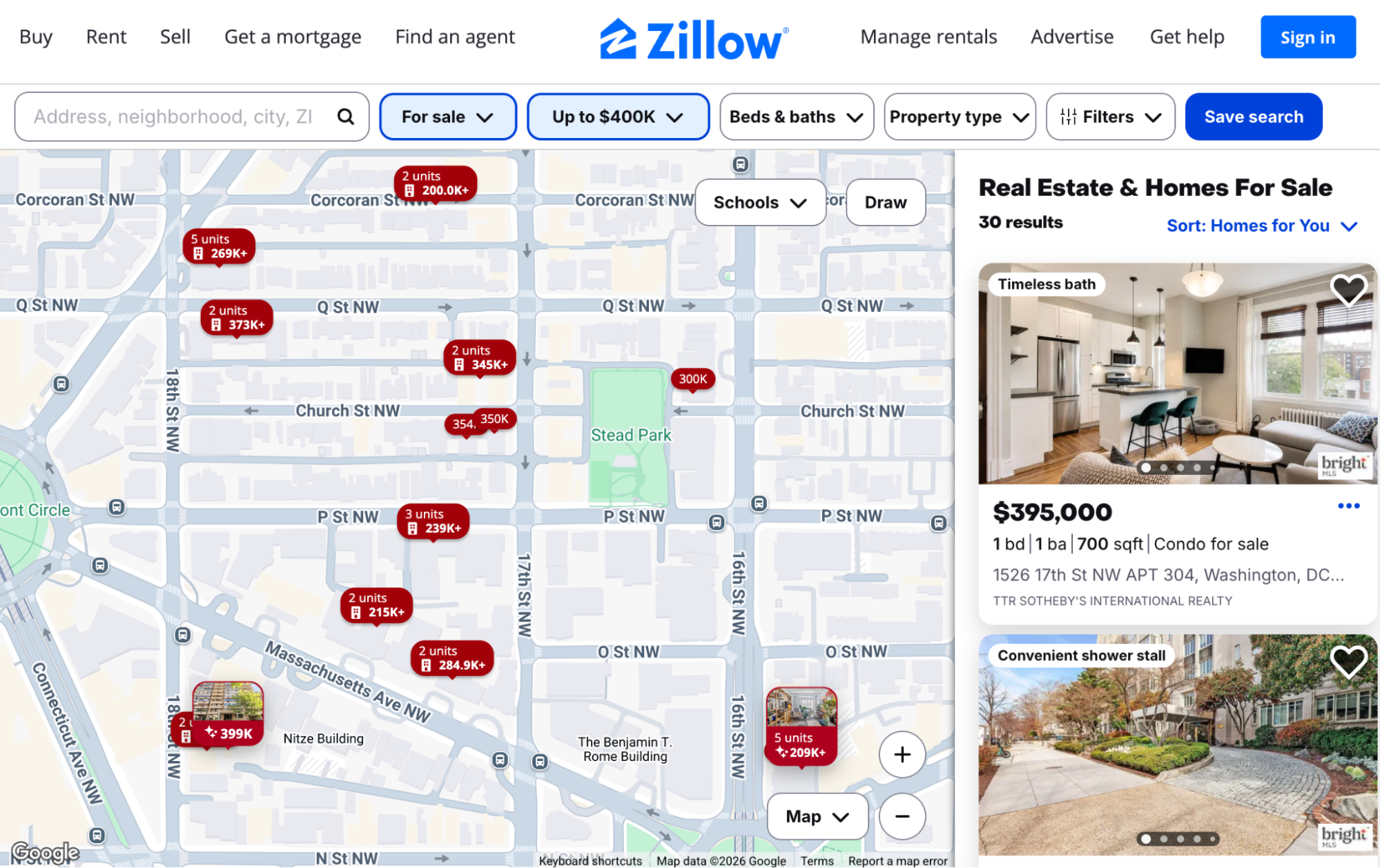
The basic map experience on Zillow, one of the world's largest property listing websites by web traffic. Listings are published via direct data feeds from MLSs or brokerages.
Technology can improve how listings are presented, but the information behind them matters far more. Agents need better ways to work with each other without constantly worrying about being cut out of a deal, and EARB can have a role in making that cooperation safer. If that can change, properties can sell or rent faster and house hunters can find the right home sooner. An MLS is only one possible way forward, but thinking seriously about what it would take to make one work exposes what is missing in the market today. Fixing the problems behind property listings is a good place to start. House hunting in Kenya should be much easier than it is.
Have you thought about what could make house hunting in Kenya work better? We'd like to hear your ideas and any other feedback. Email us at hello@plotwise.co.